whatsapp
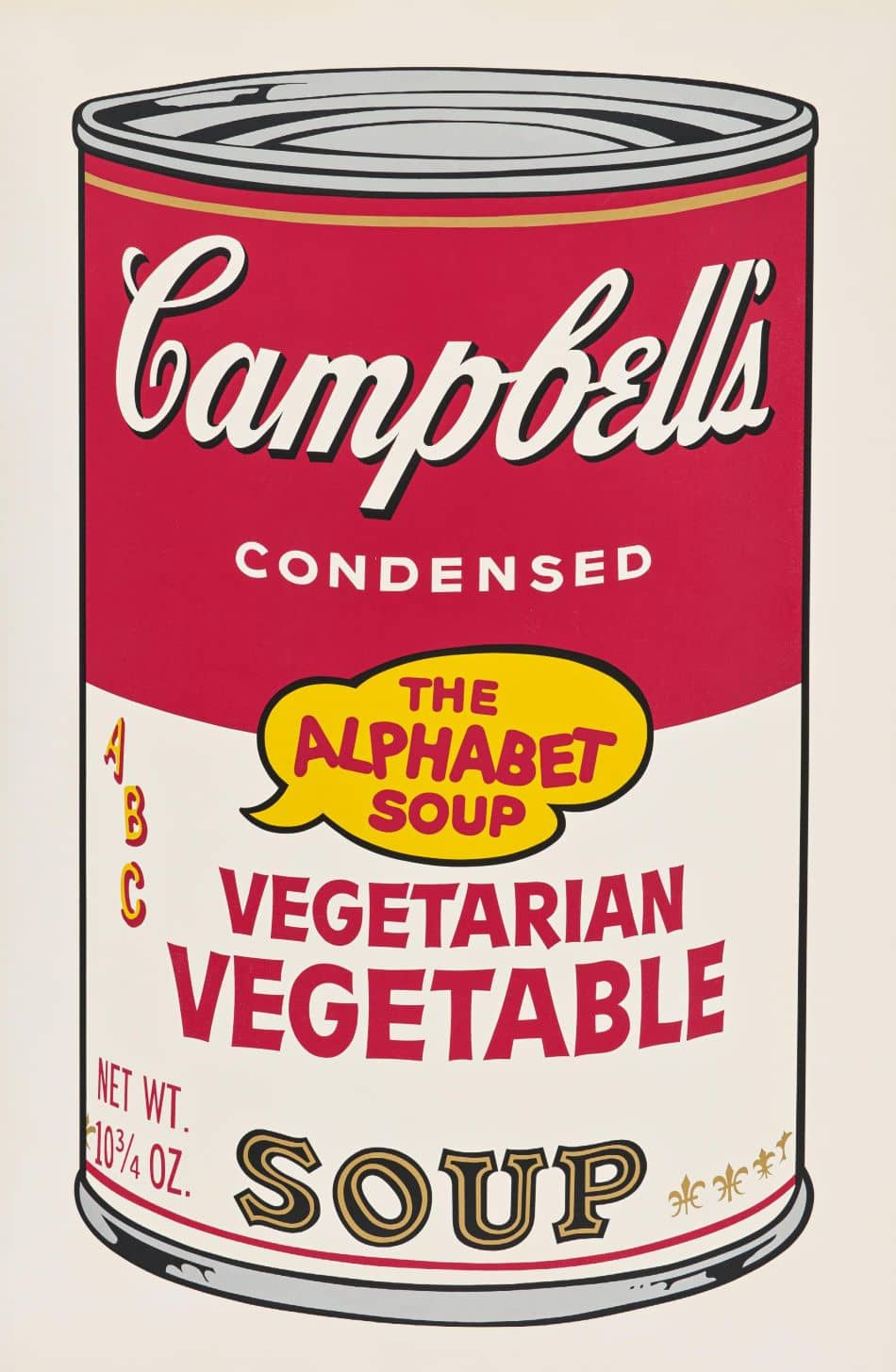
Andy Warhol Campbell’s Soup Vegetarian Vegetable (F. & S. II.56) / Screenprint / signed, numbered / edition 250
The Vegetarian Vegetable (F.S. II.56) screen print, created in 1969, is part of Andy Warhol’s world-famous Campbell’s Soup Can series, which consists of a total of 20 iconic works of art. The clear contours and contrasting colors of the graphic works give the Campbell’s Soup Cans their dynamic appearance.
| Year: | 1969 |
| Format: | 58,1 x 88,9 cm / 22.8 x 34.6 inch |
| Material: | Fine art wove paper |
| Method: | Screenprint |
| Edition: | 250 |
| Other: | signed in ball-point pen and numbered with a rubber stamp on verso. |
Andy Warhol Campbell’s Soup Vegetarian Vegetable (F. & S. II.56) / Screenprint / signed, numbered / edition 250
The Vegetarian Vegetable (F.S. II.56) screen print, created in 1969, is part of Andy Warhol’s world-famous Campbell’s Soup Can series, which consists of a total of 20 iconic works of art. The clear contours and contrasting colors of the graphic works give the Campbell’s Soup Cans their dynamic appearance.
| Year: | 1969 |
| Format: | 58,1 x 88,9 cm / 22.8 x 34.6 inch |
| Material: | Fine art wove paper |
| Method: | Screenprint |
| Edition: | 250 |
| Other: | signed in ball-point pen and numbered with a rubber stamp on verso. |


The Campbell's Soup Cans series shows Warhol's fascination with everyday objects of consumer society and represents one of the most important series of the Pop Art movement.
Andy Warhol – Campbell’s Soup Vegetarian Vegetable (F. & S. II.56).
| Year: | 1969 |
| Format: | 58,1 x 88,9 cm / 22.8 x 34.6 inch |
| Material: | Fine art wove paper |
| Method: | Screenprint |
| Edition: | 250 |
| Other: | signed in ball-point pen and numbered with a rubber stamp on verso. |
Andy Warhol - Campbell’s Soup Vegetarian Vegetable (F. & S. II.56).
Andy Warhol – Campbell’s Soup Vegetarian Vegetable (F. & S. II.56) is a silkscreen print by American pop art artist Andy Warhol. One copy is in the permanent collection of the MET, The Metropolitan Museum of Art in New York.
Before becoming one of the most famous artists of the post-war period, Andy Warhol was a highly successful commercial illustrator in New York City. After studying graphic design and painting at the Carnegie Institute of Technology (now Carnegie Mellon University), he moved to New York City, where he earned his living creating images for advertising and fashion magazines. He continued to create artworks that he exhibited in various small galleries and other venues in New York, but Warhol considered his commissioned work to be distinct from his artworks, which at that time often reflected the legacy of both Abstract Expressionist artists and the influence of younger artists such as Jasper Johns and Robert Rauschenberg. Warhol found the templates for his artworks in advertisements, comics, and stories from magazines and newspapers. Active brushstrokes combined with drips and splatters served not only as signs of gestural impulse, but also as a kind of reference to creativity and originality, made visible in reference to artists of the previous generation. Paradoxically, however, it was precisely by adopting not only the visual language of mass culture, but also its aesthetics and means of production, that he developed the characteristics that made his art so distinctive and influential. Around 1962, Warhol turned to a more graphic and detached style, characterized by bold and often contrasting colors, clear contours, and commercial imagery. Screen printing was well suited to his art, as it allowed him to repeat images from photographic models multiple times—even within the same painting or print—in different media and colors. It also allowed him to emphasize both the detached quality of the process and the imperfections (such as uneven color tones, smudges, gaps, and signs of irregular printing) that are common in commercial production. Marilyn and the Marilyn portfolio were the first prints Warhol produced and published through Factory Additions, New York, a company he founded to produce and distribute prints featuring the motifs for which he was best known—such as Marilyn, Campbell’s Soup, and Flowers.
The name refers both to Warhol’s studio, known as The Factory, and to the phonetic similarity of “additions” and “editions,” the latter being a term from printmaking that refers to the number of identical prints made from a matrix, often signed and numbered by artists. Warhol’s fascination with popular culture and consumerism led him to explore subjects that were considered mundane and ordinary. In 1962, he turned his attention to Campbell’s Soup cans, a ubiquitous symbol of American mass production and consumption. Warhol saw these cans as representative of the homogenization and repetition in contemporary society. The Campbell’s Soup series consists of 32 canvases, each depicting a different flavor of Campbell’s Soup. Warhol used a combination of painting and silkscreen techniques to create these works.
He projected an image of the soup can onto the canvas, sketched it, and then filled in the colors with bold and vibrant tones. The resulting images were precise and sharp, reminiscent of advertising and mass production. At the same time, he created two series of ten prints each: Campbell’s Soup I from 1968 and Campbell’s Soup II from 1969. By elevating the Campbell’s soup can to the realm of high art, Warhol challenged traditional notions of what constituted a worthy subject for artistic exploration. He blurred the boundaries between fine art and commercial culture, forcing viewers to reevaluate their preconceived notions about the limits of art. The Campbell’s Soup series not only broke down the boundaries of artistic subject matter, but also revolutionized the way art was produced and consumed. Warhol’s use of screen printing allowed him to create multiple identical images that mimicked the assembly line process of mass production.
This technique emphasized the theme of repetition and consumer behavior, while also making his art more accessible and reproducible. The impact of the Campbell’s Soup series cannot be overstated. It marked a turning point in art history, challenging prevailing notions of what art should be and paving the way for a new generation of artists inspired by everyday objects and popular culture. Warhol’s work also cast a shadow over the rise of consumerism and the influence of branding in today’s society. Today, the Campbell’s Soup series is an iconic representation of Andy Warhol’s artistic vision and the Pop Art movement as a whole. It continues to captivate audiences with its boldness, simplicity, and cultural commentary. With this series, Warhol not only immortalized a simple can of soup, but also left an indelible mark on the art world and forever changed the way we perceive and appreciate art. Andy Warhol, a prominent figure in the Pop Art movement, created two iconic print portfolios featuring Campbell’s soup cans in 1968 and 1969. Known as “Campbell’s Soup I” and “Campbell’s Soup II,” respectively, these portfolios illustrate Warhol’s fascination with consumer culture and his ability to transform everyday objects into works of art. Warhol first gained recognition in 1962 for his paintings of Campbell’s soup cans, which were seen as a direct challenge to traditional notions of art. The soup cans represented the mass production and ubiquity of consumer goods in American society. It was not until six years later that Warhol revisited this theme, this time in the form of printmaking. Campbell’s Soup I, from 1968, consists of ten silkscreen prints, each showing a different flavor of Campbell’s soup. Warhol meticulously reproduced the iconic red and white Campbell’s soup label, capturing every detail of the packaging. The prints were produced using screen printing, a technique that allowed Warhol to reproduce images with mechanical precision. This process also enabled him to mass-produce his works, blurring the line between art and commercial production. The following year, in 1969, Warhol released “Campbell’s Soup II,” which included an additional set of ten soup can prints. Like its predecessor, this portfolio featured a variety of soup flavors, underscoring the repetitive and uniform nature of consumer culture. All of the prints in this series were also produced using silkscreen printing, resulting in sharp lines, bright colors, and a sense of detachment from the artist’s hand. Both portfolios demonstrate not only Warhol’s technical proficiency in printmaking, but also his ability to transform everyday objects into symbols of American society.
By elevating Campbell’s soup cans to the status of art, Warhol challenged the traditional concept of what could be considered a “worthy” subject for artistic representation. These portfolios became emblematic of Warhol’s entire oeuvre, in which he explored themes such as mass production, consumerism, and the intersection of art and commerce. Through his innovative use of printing techniques and choice of subjects, Warhol catapulted himself to the forefront of the art world and left an indelible mark on contemporary art history. Today, Andy Warhol’s Campbell’s Soup portfolios remain highly sought after and are celebrated as iconic examples of Pop Art. They testify to Warhol’s enduring influence and his ability to challenge established norms and invite viewers to reevaluate the boundaries of art and the significance of everyday objects in our cultural landscape.




Year: 1969
Format: 58,1 x 88,9 cm / 22.8 x 34.6 inch
Material:Fine art wove paper
Method:Screenprint
Edition:250
Other:signed in ball-point pen and numbered with a rubber stamp on verso.