whatsapp

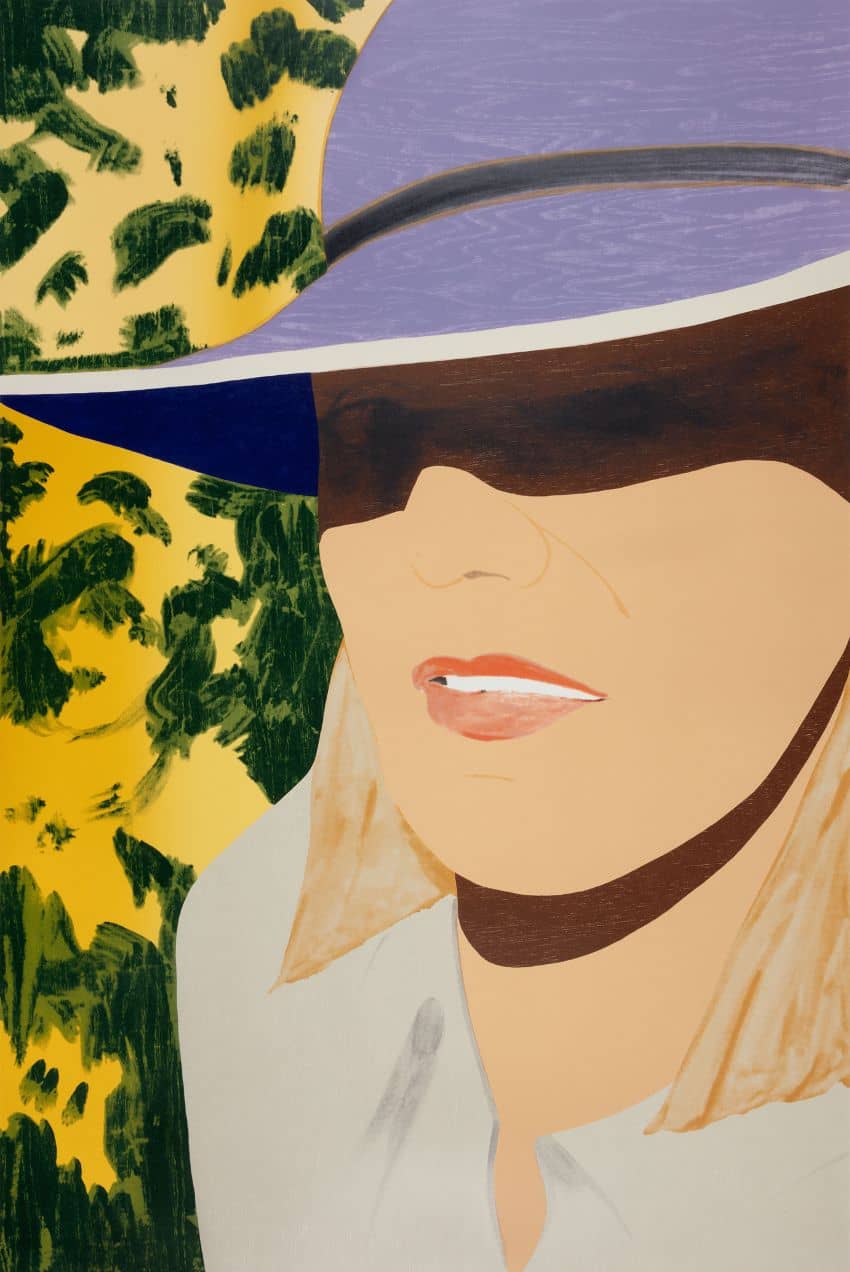
Alex Katz Sunrise 4 / Woodcut / signed, numbered / edition 50
| Year: | 2026 |
| Format: | 123 x 82 cm / 48.4 x 32.3 inch |
| Material: | 22-run lithograph/woodcut |
| Method: | Woodcut. |
| Edition: | 50 |
| Other: | hand-signed, numbered. |
Alex Katz – Sunrise 4 – Portrait with Purple Hat.
| Year: | 2026 |
| Format: | 123 x 82 cm / 48.4 x 32.3 inch |
| Material: | 22-run lithograph/woodcut |
| Method: | Woodcut. |
| Edition: | 50 |
| Other: | hand-signed, numbered. |


Alex Katz Sunrise 4 - Portrait with Purple Hat.
“Sunrise 4” is a portrait by Alex Katz depicting a young woman wearing a purple hat. Katz, who has long been interested in fashion—as seen, for example, in “Black Dress”—often draws inspiration from the American upper-middle-class sportswear typical of Maine or the Hamptons. The light in Maine was also a revelation to him, as he writes in his memoirs: “richer and darker than the light in the Impressionist paintings. It helped me break away from European painting and find my own vision.” A few years later, Katz, the artist Lois Dodd, and Katz’s then-wife Jean Cohen—an abstract painter whom he had met in school and married in 1950—purchased a house (the yellow farmhouse that frequently appears in his paintings) and a plot of land in Lincolnville, Maine, a small coastal town near Camden. (They paid $1,200 for it.) The couple divorced in 1956, but Katz kept the house. The light—and in particular the light in Maine, which makes the grass and leaves seem to melt and hits a lake with the dazzling brightness of a mirror in the sun—was, one might say, to become the true subject of his landscapes.
In Los Angeles in 2023, a highly acclaimed Alex Katz exhibition took place at the Schindler House of The MAK Center for Art and Architecture.
The title was “Alex Katz: Sunrise.”
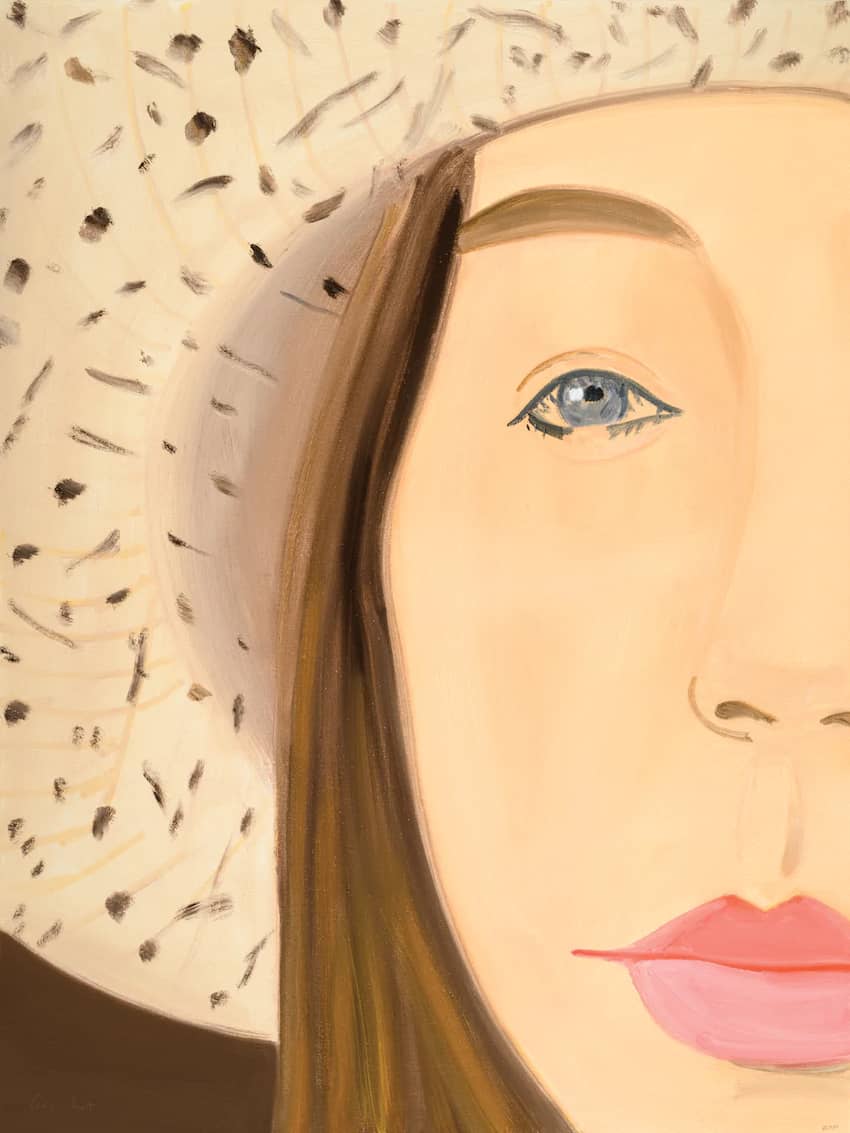
The works in the Alex Katz exhibition are all from the artist’s ongoing series, which he calls “Splits.” Using a cut-up technique, he combines inspirations from Manet’s paintings of women wearing hats in the sun, the fragmented visual worlds of early Cubism, and the “cheap” aesthetic from Fassbinder’s *Beware of a Holy Whore*. These large-format, immersive portraits of Sunrise Ruffalo capture the fleeting nature of the gaze in everyday life.
In late 1950, following a period of creative uncertainty, Katz began to focus increasingly on portrait painting. He painted his own circle of friends and, above all, his second wife and muse, Ada del Moro, whom he met in 1958. She became his most frequent model and is the subject of more than 1,000 works. Katz explained that his sole aim was to reproduce the appearance of the person portrayed—their superficial dimension—without becoming emotionally involved. At this point, he began using the flat, monochromatic backgrounds that would become one of the hallmarks of his style. The figure is depicted detached from the background in a bare space devoid of spatial references, objects, or light sources. Shortly thereafter, influenced by movie screens and billboards, Katz began creating large-format paintings, marking a turning point in his career. His intention at that time was to transpose figurative painting onto the large-canvas format characteristic of the Abstract Expressionists—something no one had done before. However, as he enlarged the canvas, he also enlarged the face of the subject, which is why he began painting large close-ups of portraits against monochromatic backgrounds, featuring fragmented facial features and often very tight compositional cropping, even drastically cropping the face. This is evident in works such as “The Red Smile” (1963) and “Red Coat” (1982), in which red is the dominant element. Katz continued to explore the possibilities of portraiture by creating series on a single canvas. A portrait could appear twice or multiple times, similar to a photographic contact sheet or still frames in a film. He remained committed to his idea of not conveying the subject’s personality and not depicting them in different roles or at different moments in their lives, but rather of presenting the subject itself. Alex Katz’s “The Black Jacket” (1972) combines five images in a sequence and offers perspectives from various frontal and profile views. Katz’s early repetitions predated those of Andy Warhol, and his technique is entirely different: While Warhol automated the process through the use of silkscreen printing, Katz repainted the image anew with each repetition, resulting in a different outcome every time.
ALEX KATZ was born in 1927 in Sheepshead Bay, Brooklyn, and grew up in St. Albans, Queens, where his family moved in 1928, shortly before the onset of the Great Depression.
His earliest aesthetic influences came from his parents, who had met in Russia during World War I and reunited in New York City. His mother, Sima, was an actress—a star of the Yiddish theater on the Lower East Side who performed under the stage name Ella Marion. She was “very literary,” says Katz—she taught herself English with the help of a dictionary and a collection of Edgar Allan Poe’s poems, which she also had her four-year-old son recite—and she had a biting sense of humor. In his memoirs, Katz recounts that he once said to her as they parted ways in a hotel lobby, “It was terribly nice talking to you,” to which she replied, “I hope you don’t paint in clichés.”
As a pioneer of Pop Art, he always focused on the essentials and explored simplified forms and high-contrast color compositions from an early stage. His art is diverse, yet beauty remains its central theme. The artist has had more than 200 solo exhibitions and around 500 group exhibitions; his diverse works are part of over 100 collections worldwide. Alex Katz lives and works in New York and Maine.






Year: 2026
Format: 123 x 82 cm / 48.4 x 32.3 inch
Material:22-run lithograph/woodcut
Method:Woodcut.
Edition:50
Other:hand-signed, numbered.